Showing posts with label Ramesses. Show all posts

Sunday, July 15, 2018

ABU SIMBEL

HISTORY

The site of Abu Simbel is home to two of the most magnificent temples from Ancient Egypt; the temples of King Ramesses II and his wife, Queen Nefertari. These temples are located south of modern day Aswan not far from Egypt’s border with Sudan. In ancient times, this site was around the 2nd cataract of the Nile River near Nubia. 

While scholars agree the temples were built during Ramesses’ reign in the 19th dynasty, there is dispute concerning the construction start date. Some scholars believe work on the temples started around 1264 BC to commemorate the pharaoh’s victory against the Hittites during the famous Battle of Kadesh. Others argue that construction began around 1244 BC which is about the time Ramesses and his sons held military campaigns against Nubia hence the chosen location for the temples. 

Today, the temples are located a distance away from their original location. When Egypt started the construction of the Aswan High Dam in the 1960s, which in turn created Lake Nasser, the temples were moved to higher ground. An international crew cut the cliffs and temples into blocks and moved the pieces about 688 ft back and 213 ft above their original position. 

FAST FACTS 

The main temple was built to honor the gods Amun, Ra-Harakty, and Ptah and to celebrate Ramesses’ military victory at the Battle of Kadesh. At the back of the temple, in the innermost sanctuary, there is a room with four statues - one each of the aforementioned gods and one of the pharaoh. Twice a year, generally February 22 and October 22, the morning sun lines up perfectly with the center hallway and lights up the statues. 

The entrance of the main temple is flanked by four seated figures of Ramesses each measuring 66 ft in height. At the base of each statue are carvings of small figures depicting the pharaoh’s children, his queen Nefertari, and his mother queen Ti.

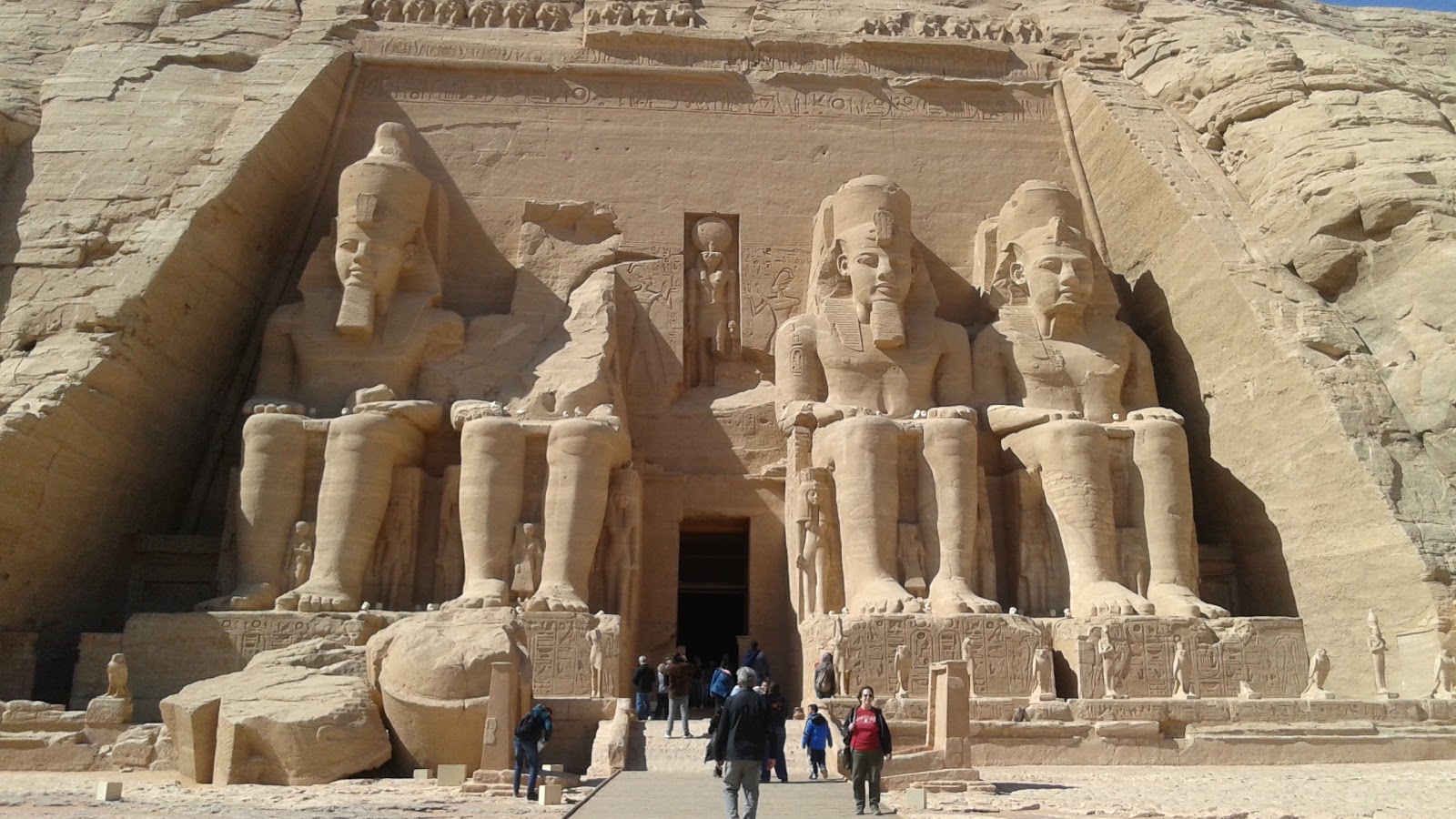


In the interior of the main temple there are three consecutive halls extending 185 ft into the cliff with these halls flanked by statues of Ramesses. 

The second temple is dedicated to Ramesses’ favorite wife, Queen Nefertari, and the goddess Hathor. Its entrance is decorated with several statues of the pharaoh and the queen each having a height of 35 ft. 


The temples at Abu Simbel were discovered in 1813 by a Swiss researcher, Johann Ludwig Burckhardt, and were first explored in 1817 by Giovanni Battista Belzoni.

VISITING ABU SIMBEL

The temples at Abu Simbel are definitely worth the visit; however, getting to the site can be quite the journey. Tourists can either fly to Abu Simbel or make the trek via driving which takes 3 to 4 hours each way. The former is obviously more expensive but the latter can be a test of patiences. I have visited Abu Simbel twice and both trips were via EgyptAir departing from the Aswan International Airport. On my first trip, the optional tour to Abu Simbel was $264 while on this recent visit, it was $293. These tours included transportation to and from the Aswan International Airport, the flight, transportation to and from the site, and admission to the temples. The flight generally lasts around 45 minutes and tour groups are given approximately two hours to explore both temples. 


The downturn in tourism has greatly impacted the trips to Abu Simbel mainly in that there are only a handful of flights to the site. Before the Egyptian revolution of 2011, there were plenty of flights to the temples each day but now, from Aswan International Airport, there are only a few flights offered twice a week. The alternative to flying is driving to Abu Simbel with drives originating from Aswan and the round trip lasting several hours. 

When I went to Egypt in 2010, the flight departed on time and we had a full two hours on site which was great because Abu Simbel was packed with tourists and vendors. Unfortunately, things did not go according to plan on this recent trip since our flight was delayed by almost an hour. This delay cut our time at the site in half giving my tourmates and I just one hour to explore the two temples, which fortunately was sufficient since Abu Simbel was practically void of tourists. I honestly think there were less than 100 people at the site the morning my tour group visited the temples. 


While the majority of trips last just a few hours, there are several lodging options available at Abu Simbel for those who are interested in spending more time at the site. Overnight stays are especially popular on the two days of the year that the morning sun lines up with the central axis of the main temple lighting up the statues in the inner sanctuary.

NOTE If flying to Abu Simbel, request a window seat on the left side of the plane. This provides the opportunity to catch a glimpse of the temples from the sky. 


NOTE If you have mobility issues, I highly recommend you request a golf cart ride to the temples. It is a considerably long, steep walk to the temples from the parking lot and vice versa. 

NOTE When traveling with a tour group, tell the guide that you are interested in the Abu Simbel postcard set. You are not allowed to take pictures inside the temples but there are some really good quality postcards available from certain vendors.


Monday, June 18, 2018

TEMPLE OF LUXOR

HISTORY

The Temple of Luxor is located on the east bank of the Nile River in modern day Luxor. In ancient times, the city was called Thebes and it was the thriving capital during much of Ancient Egypt’s New Kingdom. Construction on the temple was initiated in the 18th dynasty by the Pharaoh Amenhotep III with work continued by King Tutankhamun and Horemheb. The Pharaoh Ramesses II expanded the temple during his reign in the 19th dynasty and in the Ptolemaic period, a shine was built and dedicated to Alexander the Great. 

This temple is unique in that it is still “operating” through the Mosque of Abu Haggag. After the Ptolemaic period, during the Christian area, the temple’s hypostyle hall was converted to a church. Then, with the passage of time, the Temple of Luxor was buried under the Saharan sand resulting in a mosque being built over the structure. Today, the mosque is still attached to the temple with the east wall and doorway visible from the temple’s Courtyard of Ramesses II.  


FAST FACTS

At the entrance of the temple, in front of the first pylon, once stood two 80 ft pink granite obelisk built by Ramesses II. Today, only one remains since the other was taken by the French and now stands at the Place de la Concorde in Paris. 


The pylon at the entrance measures 24 meters high by 65 meters wide and serves as a storyboard showing Ramesses at the Battle of Kadesh - the west tower depicts the pharaoh with his advisers and generals while the east tower shows him driving his chariot over the enemies. 


Upon passing the pylon, one enters the Court of Ramesses II which measures 188 ft long and 168 ft wide. The courtyard is outlined by 74 papyrus styled columns with capitals resembling flower buds. In the southern section there are several standing colossi of Ramesses II while in the northwest corner of the courtyard there is a shrine to Thutmose III. 


The Court of Ramesses II is connected to the rest of the temple via a colonnade that consists of 7 pairs of columns measuring 52 ft in height. Those columns have capitals designed as open flower papyrus. Amenhotep III started work on the colonnade with construction completed by Tutankhamun. 


The second courtyard at the Temple of Luxor is the Court of Amenhotep III. This courtyard measures 148 ft long by 184 ft wide and consists of double rows of papyrus styled columns. The northern section of the Court of Amenhotep III was the original entrance to the temple. 


The Court of Amenhotep III leads to the hypostyle which has 32 columns and is adjacent to four small rooms plus an antechamber leading to the birth room, the chapel of Alexander the Great, and the sanctuary.

The Temple of Luxor has a statue of King Tutankhamun and Queen Ankhesenamun, who was also Tut's half-sister. This statue is beautiful in that it is one of the very few statues depicting the boy king. 


VISITING TEMPLE OF LUXOR 

The Temple of Luxor is a standard item on most tour itineraries and on the to-do list for many independent travelers. A trip to this temple is usually paired with a visit to the Karnak temple complex located just a few short blocks to the north. In ancient times, these two sites were connected by an ‘Avenue of Sphinxes’; a road approximately 1.5 miles long flanked by sphinxes on both sides. Today, archeologists are recovering and restoring large portions of this avenue.


Unlike the Karnak temple complex, the Temple of Luxor is a lot smaller and tends to generate fewer crowds. When I visited the Temple of Luxor in 2010, my tour group went at 8:00PM and we were the only ones at the site. While it was great being the only group at the temple, a night visit was not nice in that it was difficult to see the details and colors on the columns and walls. My 2018 trip to the temple was during the day which afforded the opportunity to really enjoy the details and many colors. Also, despite it being day time, the crowds were almost nonexistent.


NOTE While the Temple of Luxor is a standard item on most itineraries, not all companies include the admission to this site in the tour price. Contiki used to include both the Temple of Luxor and Karnak in the tour price but now both sites are considered ‘optional’ and an extra expense. As for traveling with Trafalgar, they include in the tour price the admission to the Temple of Luxor. 

NOTE I found this to be the most accessible temple; the ground was relatively even and there were no stairs. Also, since the temple is not that large, there is not a substantial amount of walking. 


Monday, April 9, 2018

KARNAK TEMPLE

HISTORY

The great Karnak temple complex is considered to be one of the largest religious sites in the world covering over 200 acres on the Nile’s east bank in modern day Luxor. The Ancient Egyptians called Karnak Nesut-Towi, ‘Throne of the Two Lands’, Ipet-Iset, ‘The Finest of Seats’, and Ipt-Swt, ‘Selected Spot’ with Ipt-Swt being a reference to the belief that Thebes was the first city founded on the primordial mound.

Karnak is comprised of multiple temples that were built over a span of 2,000 years starting in the Middle Kingdom with the pharaoh Senusret I and continuing through the Ptolemaic Period. The construction and expansion of the Karnak temples parallels the building projects of the 4th dynasty pharaohs at Giza in Lower Egypt. Within the complex, the largest temple is dedicated to Amun - king of the gods -  while several of the smaller temples were dedicated to the gods Osiris, Montu, Khonsu, and Ptah and the goddesses Isis and Hathor. Towards the end of the 18th dynasty, there was one temple dedicated to the god Aten but it was destroyed after the reign of Akhenaten when Ancient Egyptians resumed the worship of Amun. Furthermore, several temples were constructed to honor the pharaohs Senusret I, Amenophis II, and Ramesses II. 

FAST FACTS

The god Amun is part of the Theban Triad along with his wife Mut and their son Khonsu, the moon god. Amun rose in importance during the New Kingdom when his name was merged with that of the sun god Ra to become Amun-Ra, King of the Gods. Amun’s temple is the main structure at Karnak while Mut has a smaller temple bordering a sacred lake in the Southern Temple Precinct. Khonsu’s temple is south of the Temple of Amun near the Gateway of Euergetes I (Euergetes was a king during Ptolemaic Period). 

The temple complex has 10 pylons: one through six have an east-west orientation leading towards the Nile while pylons seven through ten were built at a right angle to the first six. Pylon 1 was actually the last to be constructed but the project was never completed; the north tower is a little over 30 feet shorter than the south tower and portions of the mud brick ramps used during construction are still visible in the first courtyard. Another sign of incompletion is the lack of inscriptions on the pylon. 

The pylon that was never completed as seen by
the height difference and lack of inscriptions. 

Behind the tree, one sees a portion of the
mud brick ramp used during construction.

A set of incomplete columns in the courtyard. 

One of the finest components of the Temple of Amun is the ‘Great Hypostyle Hall’  between the 2nd and 3rd pylon. The hall is comprised of 134 columns that were built to resemble papyrus stalks with those in the middle having capitals depicting open papyrus blossoms. The 12 columns that support the central nave have a height of 70 feet (21 meters) while the other columns measure 40 feet (12 meters). 

The 12 tallest columns with the capitals
depicting open papyrus blossoms. 

The smaller columns in the hypostyle hall. 

In the top center, one sees 'windows' that
were built to allow sunlight to enter the hall. 

The bright colors still visible on
the remaining sections of roof. 
King Seti I started the construction of the Great Hypostyle Hall and the project was completed by his son, Pharaoh Ramesses II. 

Historical reliefs on the outer walls depict the military campaigns of Seti I and Ramesses II in ancient Syria, Canaan, Lebanon, and Libya. 

The pharaoh depicted with the defeated enemies.
The Sacred Lake near the Temple of Amun is the largest in Egypt measuring 393 feet (120 meters) by 252 feet (77 meters). It was dug during the reign of Thutmosis III. 

The sacred lake. 
In ancient times, Karnak was connected to the Temple of Luxor via a 2 mile “Avenue of Sphinxes”. Today, archaeologists are uncovering portions of the avenue and restoring the sphinxes. 

Several obelisks were erected at Karnak; however, only two remain - those of Queen Hatshepsut and her son Thutmosis III. Queen Hatshepsut’s obelisk is currently the tallest surviving obelisk in Egypt and it is made of pink granite. When she died, her son ordered that the obelisk be covered in stone which in turn helped preserve the structure. 

Queen Hatshepsut's obelisk - top, middle, and bottom.
Towards the end of the New Kingdom, over 80,000 priests were employed at Karnak with the high priests being wealthier than the pharaoh. 

Karnak was designated a UNESCO World Heritage site in 1979. 

UNESCO is one of the organizations
that supports restoration projects in Egypt.

VISITING KARNAK 

Visiting modern day Luxor is akin to stepping into a time machine and journeying to an era when pharaohs ruled the land. A drive around the Nile’s east bank affords the opportunity to see the ruins of Karnak and the Temple of Luxor and upon crossing the river, one gets a glimpse of mortuary temples and the cliffs that house the royal tombs at the Valley of the Kings. 

Karnak is included on most tour itineraries and there always seems to be a steady crowd at the complex. My first trip to Karnak was in 2010 with Contiki and it was included in the cost; now, the company lists the site as an optional tour. On my recent trip with Trafalgar, Karnak was one of the 18 sites requiring an admission ticket that was included in the tour price. Both tours covered the same areas of the complex but Trafalgar provided free time at the end of the guided tour for us to take additional pictures and walk around the Temple of Amun at our own pace. My tour guide with Trafalgar was extremely knowledgeable sharing considerable information on the history and construction of the various structures within the Karnak complex.  

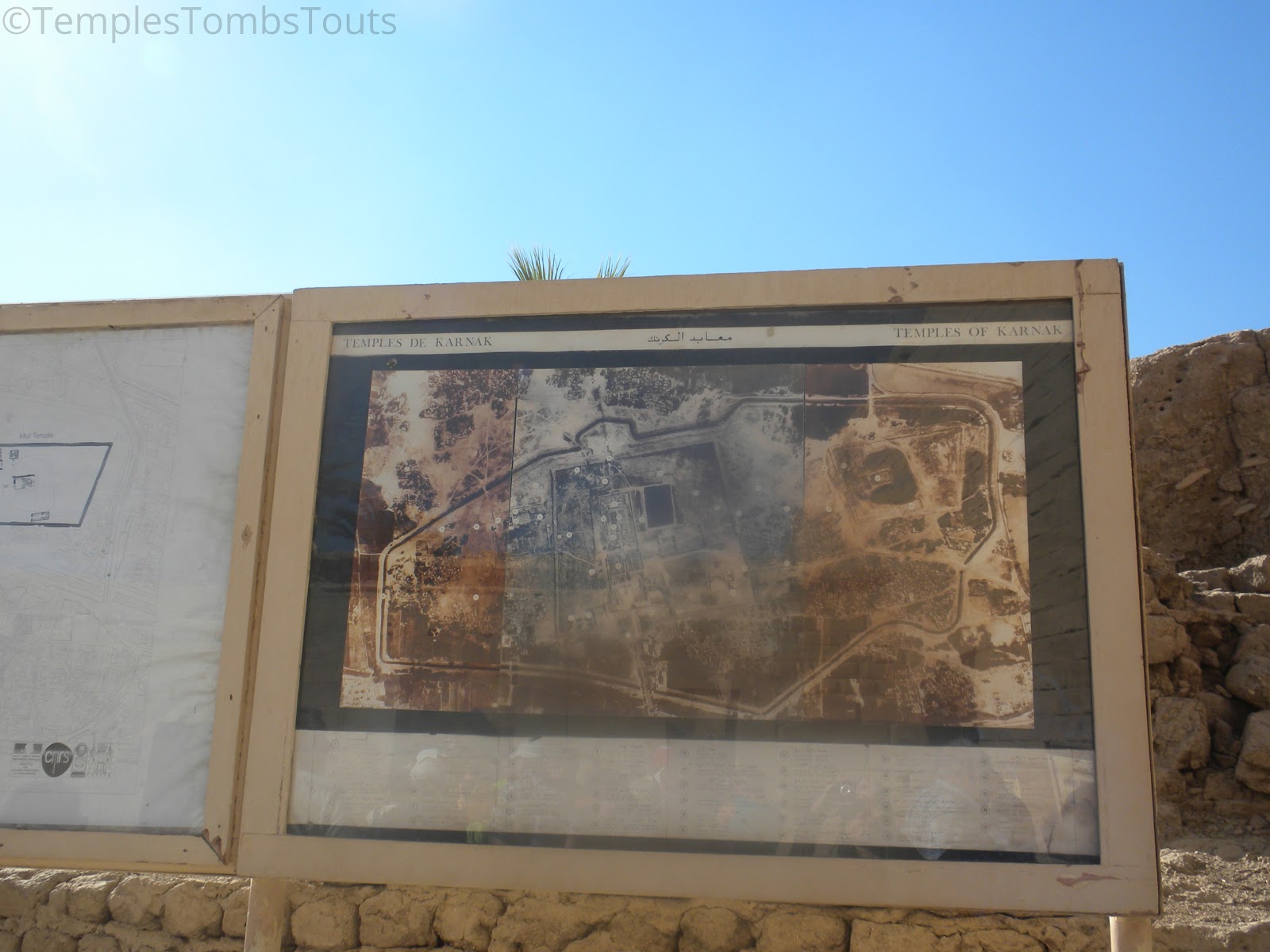
The model of Karnak found at the visitor's center. 


An aerial view of Karnak. 
My two visits to Karnak were during the late morning hours and there were sizeable crowds at that time. The crowds didn’t affect my ability to enjoy the tour but it was a hassle to take certain pictures without having hundreds of folks in the way. I have read that the complex opens at 6:00 AM so it may be worth for those traveling independently to visit Karnak at day break before the arrival of the tour groups. This will allow for better pictures and provide the opportunity to take in the beauty of the temples in silence. I recommend allotting at least 3 hours when visiting Karnak given the amount of temples one can visit plus the size of the complex. 

The admission ticket to the complex. 

The vendors at Karnak are all situated at the exit near the parking lot. Also, in my two visits, I did not see any independent guides within the complex trying to solicit business. This makes the visit to Karnak more enjoyable when compared to Giza where you have touts and guides constantly chasing you.

NOTE The ground at Karnak is relatively even so those with mobility issues should not have a problem in that regard; however, a visit to the complex requires a lot of walking and I did not see seats at the site where one could take a break. 

My favorite part of Karnak is the Great Hypostyle Hall - very difficult to put into words the feeling of awe one experiences walking around the gigantic columns covered in hieroglyphs and seeing the sections of roof painted in bright hues. And what makes it that much more amazing is the fact that the Ancient Egyptians built everything with simple tools and machinery. 

Some of the smaller columns in the hypostyle hall. 

The Avenue of Sphinxes one passes
walking towards the Temple of Amun. 

Inscriptions covering one of the
outer walls of the Temple of Amun.
A sacred scarab - walk around
it 7 times for good luck!
My travel buddy Albert sitting at the base
of one of the columns of the Great Hypostyle Hall. 


Sunday, March 11, 2018

MEMPHIS

HISTORY

Memphis is the Greek version of the Egyptian word Men-nefer which means ‘the enduring and beautiful’. Another term for Memphis was Hut-Ka-Ptah meaning ‘mansion of the soul of Ptah', with Ptah being the patron god of the city. The term Hut-Ka-Ptah was rendered Aigyptos in Greek and in turn, rendered Egypte by the French.

When Menes united Lower and Upper Egypt, he established Memphis as the first capital of Ancient Egypt. The city is located on the west bank of the Nile River south of modern day Cairo. It served as the capital during the Early Dynastic Period and Old Kingdom and in later dynasties, functioned as a religious and cultural center. The importance of Memphis to the Ancient Egyptians, even when not serving as the capital, is evidenced by the amount of building activity that took place throughout the centuries. During the 18th dynasty, Thutmose I and Amenhotep III built chapels at the great temple dedicated to Ptah and in the 19th dynasty, Ramessess II constructed several colossi. Towards the end of pharaonic rule in Ancient Egypt, the city started its decline but saw one final moment of glory when Alexander the Great was crowned pharaoh in Memphis and then buried there, though his body will later be moved to Alexandria.

FAST FACTS 

Memphis is associated with several necropolises with the major ones being Saqqara, Giza, Dashur, and Abu Rawash. 

The colossus of Ramesses II that once stood at the temple of Ptah measures about 34 ft in the given state. The statue is broken, missing a large section below the knees.

The statue of Ramesses that once guarded the temple of Ptah.

VISITING MEMPHIS

While Memphis was a major city for centuries, there is not much left for the tourist to visit except an 'open-air' museum by the modern day village of Mit-Rahina, located south of Cairo and east of Saqqara. The museum has artifacts displayed in rows around a garden filled with palm trees and a colossus of Ramesses II housed in an enclosed structure.

Admission ticket: 60 Egyptian Pounds or
$3.41 US Dollars (conversion rate as of March 2018)
This was my first visit to the museum since it was not included in the itinerary during my first trip to Egypt, which was through Contiki. On this trip, Trafalgar arranged a visit to Memphis on the same day as Giza and Saqqara. The museum was our first stop of the day and the weather was absolutely perfect, lots of sunshine and cool (in mid 60s Fahrenheit). When we arrived, our tour guide Tarek escorted us to the building housing the colossus, shared a history lesson on the statue, then gave us time to walk around the garden at our own pace. Inside the building, you have the opportunity to walk around the statue, which is displayed laying down, and to climb a set of stairs to get a better view of Ramesses. As for the garden, there is no specific start or end point so you can visit the artifacts in any order and each item has a caption, some providing detailed information. One of the greatest statues on display is the Albaster Sphinx which weights around 80 tons.

View of the colossus from the ground floor.

Alabaster Sphinx
On the right, is the building housing the colossus. 

Sample of the detailed captions accompanying the artifacts.

The museum is rather small and a visit should take no more than 90 minutes, assuming you stop to read each caption and examine each detail. If your plan is to just walk around the garden snapping a few pictures along the way, then the visit will last less than an hour. As such, if not traveling with a tour group, it may be best to arrange a stop at Memphis alongside visits to Saqqara and Dashur, which are nearby, rather than making a special trip from Cairo just to see the museum. 

A view of the back portion of the garden.
Our visit was in early January and it was cold enough for jackets and possibly a scarf. If you plan on visiting during the warmer months, definitely wear a hat and sunscreen since there is minimal shade in the garden. In terms of the terrain, the ground is pretty level with no hills so those with mobility issues should have no problem in the garden area; however, one does need to climb a few steps to enter the enclosure with the colossus. At this site, the vendors are lined up along a fence bordering the garden but they stay in this general area and will not follow you around the garden.

Towards the back is part of the stairs one
climbs to reach the second floor of the enclosure.

To the left is the vendor area at the museum.
The visit to Memphis was one of the things I enjoyed most about the trip. Aside the perfect weather, the museum was void of crowds so I had the opportunity to enjoy a leisure stroll in the garden while viewing the artifacts and taking pictures. I also liked how each item had a caption with detailed information. This may seem like common sense when presenting historical artifacts but proper labeling is lacking at several sites throughout Egypt. 


Sunday, March 4, 2018

ANCIENT EGYPT 101

Before I continue sharing tales of adventures, let us travel to Ancient Egypt to review some basic concepts. I will cover the deities and temple and tomb structures in later posts.  

Upper & Lower Egypt

In ancient times, southern Egypt was known as Upper Egypt while northern Egypt was called Lower Egypt. This is in reference to the movement of the Nile which originates in central Africa and flows northward towards the Mediterranean Sea. Thus, Upper Egypt is associated with the beginning of the river and Lower Egypt is associated with the end of the Nile, which includes the section where it branches out into channels creating the Nile Delta.

     Symbols of Upper and Lower Egypt

     Upper Egypt:    Lotus Flower; Sedge; Nekhbet, vulture goddess

     Lower Egypt:   Papyrus; Bee; Wadjet, cobra goddess


From the roof of the hypostyle hall at the Temple of Karnak.
Next to the ankh, symbol of life, is the sedge and bee. 
East vs West

The Ancient Egyptians placed a lot of emphasis on the sun as evidenced in their belief of solar gods and the location and orientation of temples and tombs. They believed the east bank of the Nile to be the ‘Land of the Living’ - the sun rose on the east each morning bringing life - thus, in the New Kingdom, they chose that location for their temples and settlements. The necropolises and funerary temples of Ancient Egypt are found on the west bank of the river since that was the ‘Land of the Dead’, the west being were the sun set every evening.

Nile River

The Nile River enabled and sustained the Ancient Egyptian civilization by providing drinking water, a means of transportation, and an invaluable resource to farmers. Furthermore, during the flood season when the Nile covered farm lands for several months, the river deposited silt which served as a nutrient rich fertilizer.

The river also has a series of six cataracts with the first found in Aswan and the sixth located in Khartoum, Sudan where the White Nile and Blue Nile converge. The first cataract generally served as the demarcation between Ancient Egypt and Nubia. Several fortresses, some now located at the bottom of Lake Nasser, were discovered around the location of the first cataract.


Today, like in ancient times, the Nile provides Egyptians with sustenance.
Picture: 2010, Aswan
Major Cities

Ancient Egypt had several cities located throughout the country all situated near the Nile River and the Nile Delta. Memphis in Lower Egypt served as the capital during the Old Kingdom and then, during the New Kingdom, the capital was relocated to Thebes in Upper Egypt. Short-term capital cities included Tanis and Pi-Ramesses in the delta and Amarna, a city towards the middle of the country.

Pharaohs

The term pharaoh is a phrase meaning “great house”, a reference to the royal residence. 

The pharaohs of Ancient Egypt had 5 names two of which were inscribed inside a cartouche, an oval outlined by a rope. 

  • Son of Ra (Also known as the nomen or birth name, written inside a cartouche) 
  • He of the Sedge and the Bee (Also known as the prenomen or throne name, written inside a cartouche) 
  • Horus name
  • Golden Horus name
  • He of the Two Ladies (Wadjet, cobra goddess, and Nekhbet, vulture goddess)

Boulder at Elephantine Island in Aswan.
Three of the five names are visible: 1) Horus name - the god Horus, depicted as a falcon, perched
on the serekh, representation of the palace facade; 2) He of the Sedge and the Bee signifying the
pharaoh ruled a unified Egypt; and 3)  Son of Ra - the duck is the hieroglyph for the word 'son'
and the image of the sun represents the god Ra
When it came to headpieces, the pharaohs had 5 styles of crowns and 1 cloth headdress.

  • White crown of Upper Egypt
  • Red crown of Lower Egypt 
  • Double crown of Upper and Lower Egypt
  • Blue crown (worn in battles and ceremonies)
  • Atef crown (worn during religious rituals)
  • Nemes headdress

Mentuhotep II, first pharaoh of the Middle
Kingdom, wearing the double crown.
Picture: 2018, Egyptian Museum
The kings of Ancient Egypt held many duties which included, but not limited to, intermediary between the gods and the people, head of the army, and High Priest of the Temples. 

Dynasties

A dating system devised by Manetho, a priest and historian from the 3rd century BC, divides the kings into 30 dynasties with changes in dynasties being determined by factors such as a change in the ruling family or political unrest. 

Early Dynastic Period: Dynasty 0 thru 2

Notable names: Narmer became the first king of Ancient Egypt by conquering Lower Egypt and unifying the two lands initiating what will become one of the greatest ancient civilizations.

Old Kingdom: Dynasty 3 thru 6

Notable Names: King Djoser of the 3rd dynasty who constructed the Step Pyramid located in Saqqara and the Pharaohs Khafre, Khufu, and Menkaure who built the pyramids at Giza in the 4th dynasty.

Collage showing Khufu (top-right), his son Khafre (left), and grandson
Menkaure (bottom-right). Khufu built the Great Pyramid but has one
of the smallest statues. Pictures taken in 2018 at the Egyptian Museum. 

First Intermediate Period: Dynasty 7 thru 10

Middle Kingdom: Dynasty 11 thru 12

Notable names: King Mentuhotep II, like Narmer, conquered Lower Egypt to reunite the two lands after a period of political unrest.

Second Intermediate Period: Dynasty 13 thru 17

New Kingdom: Dynasty 18 thru 20

Notable names: The New Kingdom had quite the list of notable kings and queens starting with Thutmosis III of the 18th dynasty. Thutmosis III is known as the Napoleon of Ancient Egypt since he led many campaigns to expand the country’s borders and suppress uprisings from enemies. His step-mother and co-regent, Queen Hatshepsut, is one of the most successful female queens in Ancient Egypt having ruled for over 20 years and completed several major building projects most importantly the Temple at Deir el-Bahri. 

Later in the 18th dynasty, we have the Pharaohs Amenhotep IV, better known as Akhenaten, and Tutankhamun. Akhenaten brought forth major changes to Ancient Egypt mainly trying to implement monotheism with the worship of just the Aten and abandoning Thebes in favor of a new city, Amarna, as the capital. His son, King Tutankhamun, will go on to become famous not for his accomplishments as pharaoh but for the treasure trove discovered in his tomb at the Valley of the Kings. 

The 19th dynasty is where we find the legendary Ramesses II also known as Ramesses the Great. In his 67 years serving as pharaoh, Ramesses led numerous military campaigns the most famous being the Battle at Kadesh against the Hittites. He also led a multitude of building projects including the expansion of the city Pi-Ramesses in the delta. 
 
Post purchased at Abu-Simbel depicting Ramesses at the Battle of Kadesh. 

Third Intermediate Period: Dynasty 21 thru 26

Late Period: Dynasty 27 thru 30

The Late Period marked the end of pharaonic rule in Egypt. Dynasty 30 was followed by the Graeco-Roman era which is when Egypt was ruled by the Ptolemies and Cleopatras, the most famous being Cleopatra VII.