Sunday, October 21, 2018

EGYPTIAN MUSEUM IN CAIRO

HISTORY

The Egyptian Museum of Antiquities located in Cairo is home to the world’s largest collection of Pharaonic relics with an estimated 150,000 artifacts on display ranging from the predynastic era through the time of Graeco-Roman rule. The first efforts to create a national museum was in 1835 by Mohammed Ali as a means to ending the rampant looting of archaeological sites. This would lead Auguste Mariette to form the Antiquities Service in 1858 which in turn established a permanent collection of artifacts in Cairo. Mariette dedicated the remainder of his life to the museum and would eventually be first buried in the museum’s garden. His remains were then moved to the home of Khedive Ismail in Giza as were the museum’s collections. In 1902, the collections were returned to Cairo and housed in the museum’s current location by Tahrir Square. 

VISITING THE MUSEUM 

The Egyptian Museum is a two storied, pale pink building situated near the famous Tahrir Square. The museum has a small garden in the front where one comes across various stone monuments and a memorial to Mariette and other great Egyptologists. Once inside, visitors are greeted with two floors filled with statues, furniture, jewelry, funerary masks, coins, papyrus, mummies, and more. The exhibits inside the museum are arranged in chronological order with the second floor also containing the special exhibits of the Treasures of King Tutankhamun and the Royal Mummies Hall.   

A statue of a sphinx in front of the Museum.

A statue paying tribute to Mariette.

The current museum will soon be replaced by the new Grand Egyptian Museum which is being built in Giza near the Great Pyramids and the Sphinx. This museum has faced multiple construction delays but it is expected to open in 2019. 

When I first visited the Egyptian Museum in 2010, I was impressed by two things: 1) the amazing collection of interesting and beautiful Ancient Egyptian artifacts 2) the condition of the museum. Some of the items I came across did not have a caption explaining the artifact and some parts of the museum had rather poor lighting. Unfortunately, things were worse during my second visit in 2018. I noticed that sections of the museum were rather dark, some exhibits were missing items since artifacts are being transferred to the new museum, and the building itself had a rather dreary feel to it. Also, on this recent journey, I saw that the museum gift shop is now a series of vendor kiosks situated at the exit. Unlike the vendor kiosks found at other sites, these were more like stores in that there was no haggling and the items seemed to be of better quality.

As I write this post, I am at a loss as to what advice I can provide in regards to visiting the Egyptian Museum. The other day, I came across pictures showing tourists walking through empty exhibits as more items are transferred to the new museum by the day. I do know that the Treasures of King Tutankhamun and the Royal Mummies Hall are still open but it is hard to find information as to what other exhibits still contain items. I do highly suggest that if you plan on visiting the museum, try to make a trip without a tour group. The benefit of going to the museum with a tour group is that your guide can provide information on the artifacts but the tour will last only an hour or two and there is insufficient free time. During my two visits, I was only given about 30 minutes of free time which is definitely not enough to run to the Royal Mummies Hall, Treasures of King Tutankhamun, and other exhibits not toured with your group. 

NOTE I do recommend purchasing the photo pass to take pictures of the amazing artifacts throughout the museum. The only two locations where photos are not allowed is the Royal Mummies Hall and the room containing the most valuable of the Treasures of King Tutankhamun which includes the famous golden mask. 

NOTE The Royal Mummies Hall contains partially unwrapped mummies! You will be able to see their facial features, nails, and on some, their hair. These mummies may be considered graphic for some so proceed with caution. Also, there is an additional fee to visit this exhibit.


Menkaure triad.

Statue of the Pharaoh Khafre.


King Tut's throne.

King Tut's canopic jars.


Sunday, September 23, 2018

VALLEY OF THE KINGS

NOTE Pictures are not allowed at Valley of the Kings or inside the tombs unless you purchase a camera pass. I did not purchase a pass since my old camera is horrible at taking decent pictures in darker settings. As such, pictures from the tombs will be from 3rd party sources.

HISTORY

The Valley of the Kings is situated in the west bank of Luxor behind the hills and cliffs of Deir El Bahri. The site served as the burial ground (necropolis) of the New Kingdom pharaohs (Thutmose I through Ramesses X), several queens, high priests, other high ranking officials, and numerous sons of Ramesses II. Since tomb robbing was a popular hobby in Ancient Egypt, the pharaohs selected the Valley of the Kings as a burial location given its secluded nature.

The cliffs at the Valley of the Kings.
The tombs found at the Valley of the Kings vary greatly in terms of size and style but each contained store chambers and a burial chamber. The former were stocked with a myriad of items which included, but not limited to, clothes, jewelry, weapons, and furniture while the latter housed the sarcophagus containing the mummy. Furthermore, these tombs are covered with detailed paintings and reliefs portraying the pharaoh in the presence of deities and texts that served as a guide for the journey through the afterlife. Some tombs, such as the one for Ramesses VI, have a burial chamber ceiling covered with astronomical figures.

FAST FACTS

The texts found on the walls of the tombs are from the following: Book of That Which Is in the Underworld; Book of Gates; Book of Day; Book of Night; Book of the Heavenly Cow.

The first numbering system for the tombs was established by John Gardiner Wilkinson in 1827. He assigned numbers 1 through 21 on a geographic basis, from the entrance of the valley and then moving southward. As more tombs were discovered, they were numbered in chronological order.

The valley's longest tomb (KV20) belongs to Queen Hatspesut who reigned during the 18th dynasty. Her burial chamber is approximately 700 feet away from the entrance and about 320 feet below the surface.

KV5 is the site's largest and most complex tomb. This tomb was built with multiple burial chambers for the many sons of King Ramesses II.

The tomb and treasures of King Tutankhamun (KV62) were discovered in 1922 by Howard Carter.

Some tombs are well preserved while others have been damaged by time, tomb robbers, and flood waters.

VISITING THE VALLEY OF THE KINGS

The Valley of the Kings is a very interesting place to visit because unlike the necropolises found in Lower Egypt - Giza, Saqqara, and Dashur - this site is surrounded by magnificent cliffs and contains a maze of tombs each styled differently and covered in colorful reliefs. The site is a standard item on most tour itineraries and the guide will either select the three tombs for the group or he will allow each person to choose the three that pique their interest. For my first trip to Egypt, our guide selected the three tombs one of which proved a challenge to several tour mates because of the number of stairs one had to climb to enter. On this recent trip, our guide provided recommendations but allowed us to select the tombs that interested us. He also informed the group of which tombs were more challenging to visit in terms of steep climbs and descents, narrow passages, and crowds. If one is visiting the Valley without a guide, it will be wise to do some research on the tombs prior to the trip to see which ones capture your interest.

When visiting the Valley of the Kings, there are 3 key things to keep in mind. First and foremost, it is important to note that not all of the tombs are open at once so you will be limited to a handful on your visit. Secondly, your admission ticket provides entry to three ‘standard’ tombs while special tombs like those of Ramesses VI and Tutankhamun are extra fees. I paid those fees during my first visit in 2010 but this time around, the tomb of Ramesses VI was closed (per my tour guide) and I was not interested in revisiting Tutankhamun’s tomb. Ramesses VI tomb is very much worth the visit given its size, amazing artwork, and lack of crowds. King Tut's tomb is worth at least one visit but since the tomb has 'celebrity' status, the lines are long and it can get crowded inside. It should be noted, and this is the third important item, that the tomb of King Tut is the only one to display a mummy. All other mummies are either at the Egyptian Museum in Cairo or lost to history.

Photo from Tour Mate John S.
Board at the entrance that displays which tombs are open.

Between my two trips to Egypt, I have visited the tombs of Thutmose III, Ramesses III (twice), Ramesses IV (twice), Ramesses VI, Ramesses IX, Tutankhamun, and Merenptah. Of those seven, my favorites have been the tombs of Thutmose III and Ramesses VI with the former housing extensive artwork in various stages of progress and the latter displaying the famous vaulted ceiling painted to depict the night sky.

PHOTOS COURTESY OF TOUR EGYPT AND LONELY PLANET

These are photos of Ramesses VI's tomb, one of the most beautiful in the 
Valley of the Kings. A visit to this tomb is definitely worth the extra fee.  


Admission Ticket


NOTE The ground around the valley is rocky and uneven and some of the tombs contain steep climbs and descents. It is recommended that one wears sturdy, closed-toed shoes when visiting the Valley of the Kings.

NOTE When visiting the Valley of the Kings, the guards (mainly locals not actual police/security) that stand at the tomb entrances may give you a flashlight, fan, or other item to use while inside. Do not accept these items as said guards will be expecting a tip when you exit the tomb. There is sufficient light in the tombs that one does not need a flashlight.


Sunday, September 9, 2018

VEGETARIAN TOURIST IN EGYPT

Vegetarians always have to worry when traveling as to what would be the available food options in a particular country. During my recent trip to Egypt, I had no issues finding food I could eat; however, my meals leaned more towards the carbs and very little protein. Fortunately, I learned my lesson from the first trip and on this journey, I packed several single-serve peanut butter cups which really came in handy while on the Nile Cruise (bananas with peanut butter were my afternoon and late night snacks). I also took a box of protein bars. 

The following are some of the meals I enjoyed during my recent journey to Egypt. 

Le Meridien Pyramids hotel in Giza has several restaurants of which one provides a breakfast buffet with plenty of options for both carnivores and vegetarians. The three mornings I partook in breakfast, the buffet contained several types of eggs (i.e. scrambled, hard boiled, etc.), mini pancakes with a variety of syrups, different styles of potatoes, a salad bar, a section with all types of breads and cheeses, an area with yogurt and fruits, and much more. There was also a chef preparing custom made omelettes. The eggs were always delicious and I greatly enjoyed the strawberry sauce provided for the pancakes. 

Scrambled eggs, mini pancakes with strawberry sauce,
croissant, and yogurt topped with bananas. 

Scrambled eggs, mini pancakes with strawberry sauce,
mashed potatoes, sweet bread, and honeydew with apple.

Part 1: Scrambled eggs, sweet bread, and
strawberry yogurt. 

Part 2: More scrambled eggs and
tater tots. 
During my stay at Le Meridien, I had the opportunity to eat one dinner at Latest Recipe, the restaurant that also hosts the breakfast buffet. The menu was plentiful and had several vegetarian options but said options leaned towards pastas, salads, and breads. There was not much in terms of protein.  


I ordered a bruschetta (toasted bread topped with marinara sauce, tomatoes, and tons of cheese) that came with a simple salad of greens, carrots, and cucumbers. Both were extremely delicious and the meal was filling. 

The M/S Medea provided a lot of food options for all three meals but again, there wasn't too much in terms of protein sources for vegetarians. At breakfast, there was a chef that prepared custom made omelettes but during lunch and dinner, the main source of protein was cheese (mainly feta) and on two occasions they had a bean salad and hummus. 

Lunch: cheese filled pastry shells, olives, rice topped
with a tomato sauce, feta cheese, potatoes, and a pasta salad.
Breakfast: omelette, crepes, tomato
topped with cheese, and melon 
Lunch: split pea soup, mixed veggies,
toasted bread topped with cheese and
spices, and seasoned brown rice. 
Special dinner: mozzarella and tomato
drizzled with a pesto sauce. 
Special dinner: cream of
mushroom soup
Special dinner: baked zucchini topped with melted cheese,
eggplant parmesan styled dish, brown rice, veggies
Lunch: pumpkin cooked with cabbage,
tomatoes, feta cheese, seasoned
bread, and french fries  
Dessert: date tart, sweet cake,
oranges, and melon
Dinner: stuffed pepper (stuffing  was rice and veggies
in a tomato sauce), falafel, veggies, baba ganoush, and
a tahini sauce for the falafel 
Dessert: coconut macaroon,
baklava, sweet cake

Dinner: fried cauliflower, feta cheese,
steamed veggies, and brown rice
Lunch: seasoned rice, broccoli with cabbage, bread, veggies in a
tomato based sauce, and some potatoes that were not good. 

Breakfast: omelette, bread, tomatoes and
cucumbers, and a banana

Lunch: Rice, veggies, a fried potato cake,
feta cheese, tomato, and bread

Dinner: Veggies, feta cheese, something
made with potatoes, rice, and bread

Dessert: sweet cake and a side of oranges

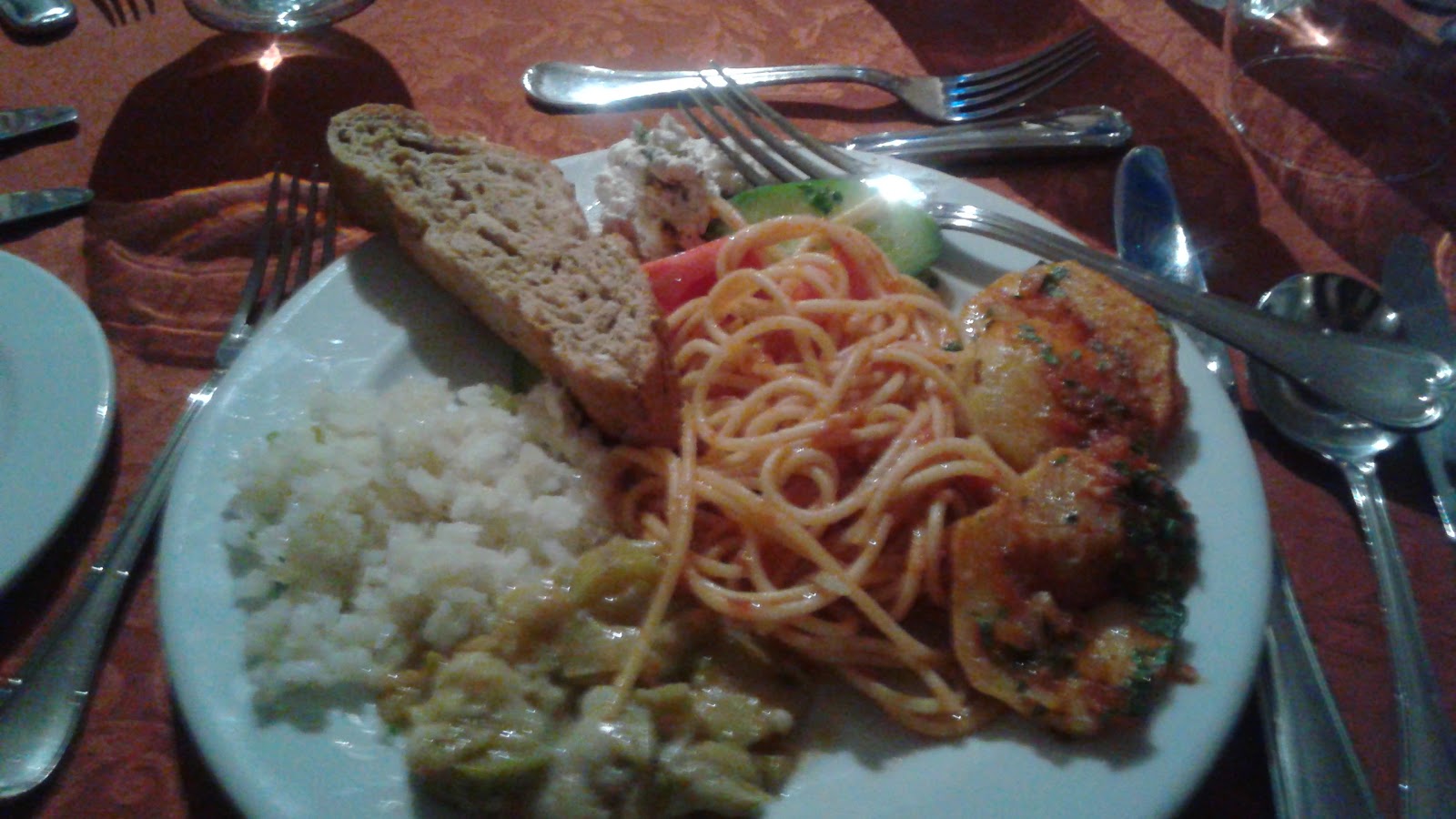
Lunch: Veggies, pasta in a spaghetti sauce, veggies, feta cheese,
mashed potatoes (they were delicious!), and feta cheese 
Dinner: veggies, feta cheese, tomatoes,
rice, and potato cakes.

For my last night in Egypt, my tour group stayed at the Ramses Hilton in downtown Cairo. The hotel had a few restaurants and we opted to go to The Citadel, which serves mainly Italian styled dishes. It had a handful of vegetarian options but again, it was all pasta.


I ordered cheese raviolis with a block of cheese (can't recall what type) and the whole meal was bland, not very appetizing, and not filling. Upon my return to the States, I did research on the other restaurants in the hotel and they seem to offer more and better quality vegetarian food options. 

My last breakfast in Egypt was also at the Ramses Hilton but it was in a restaurant that provided a breakfast buffet. Similar to Le Meridien Pyramids, the buffet provided plenty of options but the quality wasn't as good. I just grabbed some scrambled eggs, packaged yogurt with fruit, and an assortment of mini pastries. 


My final lunch in Egypt was a restaurant across from the Pyramids and the Sphinx; unfortunately, I did not take a picture of that meal. While all my non-vegetarian tour mates enjoyed a delicious meal of kebabs, yellow rice (served in the shape of a pyramid), and veggies, I was given a bowl of spaghetti with almost no sauce, two stuffed grape leaves, and two pieces of cauliflower. I would have preferred the rice and veggies over the heap of pasta. 


In short, the food was delicious but as one can see from the pictures, most meals were veggies and carbs. While the cruise meals were all you can eat, I rarely got seconds and instead opted for a banana with peanut butter in order to get protein and a more balanced lunch and dinner. 


Sunday, August 26, 2018

TEMPLE OF PHILAE

HISTORY

The Temple of Philae was built on the Island of Philae situated in the Nile River south of Aswan. In antiquity, its location was near Ancient Egypt’s border with Nubia. The term Philae is derived from the Greek and Latin versions of the island’s Egyptian name, Pilak, a reference to its location towards the bottom of the country. The temple was dedicated to the goddess Isis from the Pharaonic era up to the time of Greek and Roman rule. On the island, the oldest structures can be dated to the reign of Nectanebo I, approximately 370 BC, while those that still stand were built by the Ptolemies in the last two centuries BC and by Roman emperors in the first three centuries AD. After the end of Roman rule, during the reign of Justinian (527-565 AD), the temple was closed and some chambers were used in Christian worship. 

Today, the temple does not stand in its original location. Similar to the Temples at Abu Simbel, the Temple of Philae was in danger of being submerged by the newly created Lake Nasser after the construction of the Aswan High Dam. Between 1972 and 1980, through an international collaborative effort sponsored by UNESCO, the temple was relocated to the neighboring Island of Agilika. 

FAST FACTS

Unlike other temples in Egypt, the Temple of Philae is not symmetrical and linear given the size and shape of the island. 

The first pylon consists of two towers and a central doorway with each tower having a height of 60 feet. During ancient times, in front of the first pylon, were two granite obelisks and two granite lions. The obelisks were erected by Euergetes II. 


The main courtyard is located between the first and second pylons. It is decorated with a series of columns known for their plant-like structure and uniformity. On the west side of the courtyard, there is a Mammissi (birth house), a common feature among the Ptolemaic temples such as those found at Dendera and Edfu. 


The second pylon and doorway measure 105 feet wide by 40 feet high. As previously mentioned, this plyon is not parallel the first pylon.  


In the vestibule, there are Coptic crosses and Greek inscriptions carved into the walls and columns. These are indicators of how the temple was converted into a Christian place of worship. 


On the island, southeast of the main temple, is the Kiosk of Trajan. Construction on this kiosk started during the Roman period but it was never completed. 


VISITING THE TEMPLE OF PHILAE

The Temple of Philae is located in Aswan on an island in the Nile River surrounded by magnificent rocky cliffs. This was my first visit to the temple since it was not part of the tour itinerary when I first traveled to Egypt. It seems that the Temple of Philae is only a standard item on tours that last more than 8 days. On my recent trip, we visited the Temple of Philae the same day we stopped by the Aswan High Dam and the Unfinished Obelisk. A tour of the temple lasts approximately one hour  (guided tour plus free time) while the boat ride to and from the island is about 10 minutes each way. 

A view from the island. 
Before you arrive to the docks, you are greeted by a market area filled with stalls and very assertive vendors. Then, when you approach the docks, there are more vendors lined up on each side plus boat captains trying to sell rides to the island. We were fortunate that the boat rides are part of the tour because if not, one has to do extensive haggling to secure a decent round trip fare. And I have read on several travel sites that there are times where a boat captain will demand additional money for the return trip even though there was an agreed upon round trip price. Once on the boat and on your way, you are greeted with spectacular views of the Nile, surrounding cliffs, and various islands that dot the river. When you arrive to the island, you are greeted by more vendors but the ones on the island were nicer and generally did not bother the tourists. 


The island was rather peaceful since it wasn’t that crowded and you are away from the noises of the city. The only other temple that I experienced this peacefulness was at the Temple of Hathor in Dendera. All other temples either had a crowd or one could hear the city traffic. Also, if visiting this temple during the winter months, I recommend bringing a coat and possibly a scarf. We toured the Temple of Philae on a January morning and it was rather cold, especially because of the strong breeze. 


NOTE Those with serious mobility issues may have trouble entering and exiting the boats since the ramps are not steady and one has to really balance while stepping into and out of the vessels. Once on the island, you need to walk down a dock and up a hill to reach the temple.

NOTE In our boat, we had a gentleman that was selling Nubian jewelry and souvenir maps and postcards. Fortunately, he was not a pushy salesman; he just stood in the middle of the boat and showed us what was available for purchase. I generally do not wear jewelry but I could not resist buying this beautiful brown and white camel bone necklace ($5). All items on the boat were priced in US dollars.